29 June 2026

Mac RetroArch Setup Tutorial for Arcade Games - Part I

Update June 2024: How could I overlook the option to install/update RetroArch via Homebrew for such a long time? Added a small chapter in the Initial Setup chapter below.

Update June 2024: Some small, but great RetroArch news considered here. First, HDR screenshots work now! And the new function "Add To Playlist" is such an important usability improvement of RetroArch Playlists. Last section "Other Arcade Cores" also updated.

February 2024: so finally the RetroArch Tutorial Part II is out, but please be sure to have gone through this Part I first 😊

21 April 2023: Added a short section as regards the Steam version of RetroArch.

20 March 2023: RetroArch 1.5.0 a.k.a. ‚The MacOS Release‘ (just kidding) was released - it is a huge improvement for Macs - https://www.libretro.com/index.php/retroarch-1-15-0-release/ and everything in this article also applies to the new stable build. I have not tested the Steam version, though because updating the newest Nightly manually is very convenient on MacOS, as also described below.

About this posting: As the new Vulkan driver for MacOS is a game changer for Retroarch in MacOS, it became necessary to update this entry. Don't be too afraid of this lengthy article, it's a checklist of what RetroArch is capable of, and the result of this work is an unmatched gaming experience, even in old-school arcade games.

30 May 2026

Negatron - a MAME Desktop Frontend at its best

Update 30 May 2026: Quick summary on how to run Negatron with MAME installed via Homebrew
While this turned out to be a bit tricky, it then works nicely in the end if you follow these steps:
  1. I assume that you have a running Homebrew MAME setup (as per my separate blog entry) and that Negatron is installed.
  2. Delete/backup any existing negatron.ini file in $HOME/Library/Application Support/Negatron and restart the initial Negatron setup.
  3. In the initial config dialog, choose the Homebrew MAME executable: /opt/homebrew/bin/mame
  4. Choose the EXTRAS and Multimedia root folder: $HOME/Library/Application Support/mame (as suggested in my Homebrew setup, where $HOME must be replaced by your actual user path)
  5. In Negatron, head for the settings and change the mame.ini path to: $HOME/Library/Application Support/mame/mame.ini (as suggested in my Homebrew setup)
  6. Now, the important hack (as suggested by the Negatron developer): Exit Negatron, show the contents of the Negatron.app (right click - Show Package Contents) in the Finder and delete both SDL3.dylibs from the Contents/app subfolder -> this allows MAME to use the Homebrew SDL3 libraries instead of the Negatron ones, which for whatever reason do not work with Homebrew MAME
Now Negatron should properly launch the Homebrew MAME executable, which is glorious.

Update 30 January 2026: Negatron is back and fully working on ARM Macs - download the best MAME frontend for MacOS here.

No need for you to join the Dark Side of Negatron - Modena (Default) is bright.

MAME frontends for MacOS have always been scarce. I was surprised to learn about this Negatron MAME Desktop Frontend being available (actually since 2015!) for MacOS as well. Already after my first tests, I was impressed from its capabilities. This review tries to point to the outstanding functions, especially for MacOS users. This is a rewrite of my old 2020 post.


Version tested: 1.0.2 of January 2026 
Github NegaMAME: https://github.com/xinyingho/NegaMAME (a dedicated MAME fork)
The software is updated regularly by its developer XinYingHo.


That's why it is by far the best MAME frontend you can get for MacOS: 

  • Integration into official MAME is excellent in my testing. As I now also integrated my MAME setup into Homebrew for automatic updates, I would not want to opt for the special MAME version called NegaMAME (explained below). You can configure virtually everything in the UI, so it‘s advisable to make backups of your .ini files beforehand.
  • The interface is very customizable, even more than QMC2, and the different artwork and manuals you can add to each system is also unmatched by QMC2. Video preview also just works. See the ‚OMG‘ sections below 😉.
  • Negatron also has a smart integration of Software Lists, far better than MAMEUI and QMC2 (is broken since quire some time). I still have to look into this further.
  • Updates of MAME are recognized during the next Negatron launch, and it also updates its own databases with the new version.
  • New - SDL3 Input Mapping: With the implementation of SDL3, the entire User Interface is mapped to joypad support. 
  • Information from the developer: https://github.com/xinyingho/Negatron/blob/master/README.md

All in all, Negatron seems to be a worthy successor of QMC2. Give it a try, you will not be disappointed.

Read further for all the details.

09 May 2026

MAME (current) for RetroArch: running list of improvements

I will use this post as collector for any further improvements that we see in the MAME (current) RetroArch core.

Update 9 May 2026 - with the tremendous help of a community member, I now understand that MAME (current) still supports the .lay files of MAME official. However, due to the limitations of the RetroArch implementation, you will only need this for very special topics, but not for classical bezel artwork.

If I am not mistaken, there is no documentation of this setup anywhere - so here you are.

Very long time ago, I did a deep dive into the logic of a MAME .lay file:
With a highly capable shader such as koko-aio, there is no longer the need for such .lay file in RetroArch. However, there are things that a MAME .lay file is still valuable in RetroArch:

Configuration in the RetroArch shader, such as koko-aio:
  • Arcade machine artwork
  • Bezel configuration in every single detail
  • most Backdrops
What's left for a configuration in the MAME .lay file:
  • Screen overlays for colorizing pixels

The colorization of the pixles is done with an overlay in the MAME .lay file

In comparison without the overlay

  • Dual screen setups, like in certain Game & Watch handheld games

The alignment of the two screens is done in the MAME .lay file

  • Backdrops, like those of Game & Watch handhelds, only look good if configured in a MAME .lay file
Grass, hens and wood is in a MAME .lay file as backdrop, not in koko-aio


The apparent challenge is that you need to be absolutely sure what you need in the MAME .lay file and what not. Have a look into the two Game & Watch examples, that should help.

Installation of MAME lay files

Like in MAME official, the relevant file are compressed into a .zip file having the name of the game. In the .zip file, the layout file is called default.lay, and it contains the references to the other files in this .zip file.

Installation path in RetroArch: 
RetroArch/system/mame/artwork

For your orientation, the system folder is the folder that contains all other system data, such as bios files of consoles. Inside of this folder the mame subdirectory is written in small letters, as well as the artwork directory. Same as in official standalone MAME.

I hope that this information helps, it is incredibly hidden in the Internet. Cheers.


Update 4 August 2025 - just briefly an overdue update on easier highscore support in MAME (current) for RetroArch, which I can confirm as working (done with newest MAME version 0.279)

Preparatory steps:

  • Step 1: have the MAME (current) core installed
  • Step 2: verify that you have the following directory: $HOME/Documents/RetroArch/system/mame - if not, then create it
  • Step 3: download the entire master file from github as a zip file: https://github.com/libretro/mame and extract it
  • Step 4: move the following directories into the mame directory according to Step 2: hash and plugins
Activating Highscore Support from within MAME (current):
  • launch a game in MAME (current), enter Quick Menu, and in the Core Options/System, enable "Boot to OSD"
  • Completely close RetroArch, launch it again and launch a game (horizontal monitor!) in MAME (current) -> the OSD appears
  • With (TAB), jump to the General Settings of the MAME OSD, go to Plugins and activate "Hiscore Support" - don't forget to save the settings in the MAME OSD. 
  • After this, disable "Boot do OSD" in the Core Options and completely close RetroArch again.
  • MAME has now generated the necessary ini files in $HOME/Documents/RetroArch/system/mame/ini
From now on, games should save highscores in $HOME/Documents/RetroArch/system/mame/hiscore. Play any game and get a hiscore, and it should create this directory and save hiscores into it. 

Very good news: In my tests, I could successfully move all hiscores from MAME official to MAME (current) in RetroArch! The solution now seems compatible and stable enough.

Still a bit clumsy, but far better than before. 

Reminder: samples for very old MAME games need to be here as well - $HOME/Documents/RetroArch/system/mame/samples

Game & Watch Games in MAME with Screenshots

Finally: Game & Watch handhelds decently run in RetroArch with the koko-aio shader

This has been a major struggle, and with the spontaneous help of the creator of the koko-aio shader, these handhelds are up and running in RetroArch as well. Thanks to the capabilities of koko aio and its creator, the shader presets are compelling and even superior over official MAME.

If you want to test this out immediately, download my today's release of koko-aio with all the Arcade textures included here:

https://github.com/estefan3112/koko-aio-slang/releases/tag/0.8ng

These two Game & Watch presets are already included in the base package:


Technical Notes on the challenges:

  1. Partial reliance on MAME.lay file: For certain effects, such as a consistent overlay and a proper dual screen setup, you still need a reduced .lay file. The respective .zip files are provided in my koko-aio release (under system) and need to be placed under RetroArch/system/mame/artwork. So I had to split the layout between koko-aio (for the bezels and the shader) and the functions that koko-aio does not and will never support.
  2. MAME Alternative Renderer required: These games only look good if you use the Alternative Renderer of MAME current, which does own upscaling. In my koko-aio release, I provide game-specific .opt files for activating the Alternative Renderer and a resolution that runs on my M2 Mac Mini. Files need to reside besides the .slangp files in the RetroArch/config/MAME folder to be used automatically.
  3. Reference to koko-aio fast hires presets: As MAME does its own upscaling in the Alternative Renderer, it was very important to use one of the fast Hires shader presets. As regular koko-aio does its own upscaling, a reference to this preset resulted in very laggy performance.
  4. No Runahead or other latency option: Another very important catch is if you have Runahead or any other latency option of RetroArch enabled. Disabling Runahead (in any form) significantly improved performance. In my koko-aio release, I provide game-specific .cfg files for disabling Runahead, because for all other games, it is of great help.

The developer of koko-aio also provided a last minute patch for even nicer looks, so be sure to use my install file, which contains an entire instance of the koko-aio shader, bleeding edge.

Feel free to feedback on this release, should you run into any issues. It would also be very interesting to get feedback on performance of this setup on other machines. Thank you, and cheers!

13 April 2026

What a hideous MAME April‘s Fools Joke - and I completely fell in

When it comes to mamedev.org, I really take everything very seriously. So I was not suspicious at all when the MAME core team published its „Future plans announcement“ on 1 April 2026.

The very long post really triggered me with these highlights:
  • Focus on Windows, but no other operating systems.
  • AI-assisted code check and Rust migration
I asked myself: „Is this the end of official macOS support for MAME?“ 
I was quite disappointed … until only on 7th April 2026, the team clarified: 

„I hope you enjoyed our April Fools’ Day announcement. With that out of the way, it’s time to discuss actual upcoming changes to MAME.“ 

Congrats MAME team, you really made my day 😂.

03 March 2026

MAME via Homebrew on Macs - Finally There (and MacPorts, actually)

Update 3 March 2026: The Homebrew formula of MAME was updated to 286, which is the first MAME with SDL3 support in MacOS per default! It works well, and I see consistent performance improvements with nearly every game tested. However, I had to manually adjust my paths in the mame.ini file, which for some reason has been modified by this update. After this correction, I see a well working MAME 286 - and of course, you need to install the sdl3 package in Homebrew. Good gaming!

Update 1 February 2026: Just reporting that two Homebrew updates of MAME worked as expected. Couldn‘t be more satisfied with this setup (except for the small BGFX Artwork glitch, as explained below).

Update 14 December 2025: Added a chapter for Intel Macs and for Linux (with some basic ideas how Linux should work). I also provided initial thoughts on my tests with MacPorts (instead of Homebrew), encouraging, but not fully there.

------------- original post --------------

This is a major achievement - after several unsuccessful attempts, it seems that I have finally managed to create a near-perfect MAME Homebrew setup on my Mac. Let’s explore why this effort was worth the time.


Why does this matter?

Managing your MAME install via Homebrew should address the following major issues around any MAME installation:

  • MAME system and user files stay separately: With this setup

    • the MAME system files, which are regularly upgraded via Homebrew, stay in the Homebrew repository of your Mac, while

    • your user data, such as inis, rom files, artwork and all other content, are in a separate folder of your Mac, where MAME can find them.

  • Seamless upgrades: By keeping MAME system data separate from your user data, you upgrade MAME via Homebrew without the need for any user data migration. User data upgrades are always separate from MAME system upgrades.

  • No Gatekeeper woes: Running MAME via Homebrew does not hit Gatekeeper restrictions. MAME is treated like any other CLI tool installed through a trusted package manager. This is why you can launch it without the “macOS cannot verify the developer” or “move it to the bin” popups.

  • Launch MAME from anywhere: Just open the Terminal and type e.g. mame 1942, and the game launches. It is no longer needed to launch MAME via Terminal from the home directory.

With only one minor deficiency that needs a workaround as explained below, it’s ready. It’s really great to keep MAME up-to-date in an admin-friendly way.

Requirements for this setup on your end


  • Main instructions are for ARM64/Silicon Mac, where the necessary changes for Intel Macs are described in a separate chapter (not that difficult)
  • Basic Terminal knowledge (recommendation: iTerm2 app)
  • Basic Editor knowledge (recommendation: Visual Studio Code app)
  • An existing Homebrew installation (for Apple Silicon)
  • Understand how to access and use the hidden folder $HOME/Library/Application Support/ folder of your user account $HOME

Let's start from scratch!

16 February 2026

Emulator Frontend Deluxe (update): AttractMode+ 3.2.2 and Smart Themes Project

Update 16 February 2026: Attract Mode Plus 3.2.2 has been released. You can download fully notarized builds for ARM64/Silicon and Intel (for the time being, only newer versions of MacOS):

https://github.com/estefan3112/attractplus-applesilicon/releases/tag/3.2.2

So far I can tell, it's another splendid build, so grab it!

Original post 14 May 2025: With the new release 3.1.0 of Attract Mode Plus, the incredible work provided by the Smart Themes Project was also published. As it is hard to explain the incredible work done here in words, so here are two video teasers that demonstrate a small fraction of the work provided here.

Main menu displaying all available systems - plus filters, such as system families, favorites etc:


Sub menu "Favorites" - a glimpse into the vast number of Arcade Smart Themes (which are dedicated animated pages for single arcades that look stunning):


If you are interested, dive into the following details!

22 December 2025

Welcome back, QMC2!

Quick Hints 2 February 2025 - Running QMC2 for the first time / older MAME installs

Hint #1: Prior to running QMC2 for the first time, please ensure that your MAME install is up and running, i.e. passes the Gatekeeper. This restriction also applies to Intel Macs with modern MacOS systems installed. Without this, the QMC2 setup will not recognize QMC2 as an installed MAME application.

This applies to the MAME executable and the SDL2 Framework, which after each upgrade must again be manually authorized in the Privacy & Security section of the System Configuration.

If you hate this (like I do) -> go for the Homebrew/MacPorts install of MAME, as described in my dedicated post, and no Gatekeeper woes will infest your MAME updates. Further details on QMC2 are mostly still valid from my old post of 2016 on QMC2.

Hint #2: Scanning the ROM directory first time is very buggy in QMC2 and often results in crashes. Don't worry, just restart the app, choose the option "Once" and the scan ends. Be sure not to do any multitasking during this scan.

Hint #3: Older MAME installs - start from scratch: When you move to a newer MAME version after a longer time, the second tip I have is to start a new mame install by renaming the $HOME/Application Support/mame directory containing the old ini files. For example MAME 278 introduced new audio latency options that can make problems with old mame.ini files. So if you are stuck with launching MAME and end up in a blank screen, I recommend that you restart with a new mame.ini file. This should resolve most of the MAME black screens at program launch.

Update 23 December 2025 - First fully notarized QMC2 MacOS Binaries online

I finally managed to create MacOS app bundles (both ARM64/Silicon and Intel) that have been notarized by Apple. For this to succeed, I had to bundle the SDL2 Framework into the app bundle and codesign everything with hardened runtime. 

Grab it here: https://github.com/estefan3112/qmc2-mame-fe-MacOS/releases/tag/v244v4

Both App versions should work flawlessly - but please look into the ReadMe file if unsure.

Update 6 May 2024 - GitHub Fork with MacOS Binaries

For easier deployment, I created a fork of the QMC2 Github Repository here:

https://github.com/estefan3112/qmc2-mame-fe-MacOS

You'll find here latest pre-compiled and code-signed versions of QMC2 for both Apple Silicon and Intel Macs. You'll also find Shell scripts for compiling the Upstream source code and self-sign the app. Right now only for Apple Silicon, soon for Intel Macs as well.

Question: I downloaded the QMC2 app, but MacOS tells me that the file is corrupted. I already tried right mouse + open at least twice, but with no success.

Answer: Sorry to hear, your QMC2 app might be in the quarantine. To lift the quarantine, please execute this command in the Terminal

xattr -cr /Applications/qmc2-sdlmame.app (please adjust the path to your QMC2.app, if required)

Enjoy.

Update March 2024 - in (far too late) Memory of Rene Reucher

Only these days, far too late, I learnt that Rene Reucher, the creator of the QMC2 frontend, passed away in spring 2023. Back in 2022, when I wrote the first version of this post, Rene has restarted his work on this quite unique MAME frontend, and it was a pleasure for me to help him out on some minor things in relation to Macs, albeit nothing crucial. From two phone calls, I remember him as a very reasonable and pleasant person. This is my very late "Sorry, and all the best, Rene."

As always, please care for the instructions in the ReadMe and do report any problems back, many thanks.

I started MAME with the help of QMC2, and it is still a classic frontend experience

Original post in the following (no longer relevant and rather outdated, as it builds nicely now with Homebrew):

03 December 2025

DarkPlaces / Quake 1 for Apple Silicon/ARM64 + Intel Builds - Ready for Download

I’m pleased to provide MacOS DarkPlaces builds, fully codesigned and notarized, for download and use on Silicon aka ARM64 as well as Intel Macs. The builds are packaged in a sleek DMG for easy installation. Thanks to notarization, also Gatekeeper on ARM64 macOS systems poses no issues. An Intel Mac build landed as well as of 5 Dec 2025.

https://github.com/estefan3112/DarkPlaces-Apple-Silicon-Builds/releases/tag/1.0

This video above is a quick, freehand iPhone recording showcasing DarkPlaces with hires textures running on an M1 Mac Mini connected to a 48-inch TV at 4K resolution. While there are some initial FPS struggles, overall the performance is quite impressive.

Celebrating Quake and DarkPlaces

Quake was the most expensive game I ever bought, since I had to upgrade to a Pentium PC just to play it. I still celebrate the game for its feel, its dark and atmospheric mood, and the brilliant Nine Inch Nails soundtrack (including the idea to have a NIN gun ;-). While many Quake adaptations have been enjoyable, DarkPlaces stands out as the best implementation on modern hardware. You can read more about it here:

https://icculus.org/twilight/darkplaces/

https://github.com/DarkPlacesEngine/DarkPlaces

Self-compilation has always been possible, but a ready-to-play binary for modern Macs was missing. Thanks to the help of AI (yes, it has its advantages), I was able to overcome the final hurdles and now provide this software package as a direct fork of the official Github server.

Requirements for running Quake in DarkPlaces

15 November 2025

Emulation Update November 2025

November 2025 — an excellent opportunity to present a broad overview of updates in macOS emulation. Since this will cover a diverse range of topics, I plan to combine this post with updates to the corresponding main articles, including links to them. Let’s see how well this approach works, and I hope you enjoy the read.

News Nr 1 - macOS 26.1 “Tahoe” has landed smoothly. 

Despite the widespread criticism surrounding macOS 26 and iOS/iPadOS 26, I actually like all of them. As usual, I waited for the .1 release before updating, and the process went without a hitch. 

The emulators are running well, and I’ll be providing an update on them below anyway.

News Nr 2 - Scaled Resolution and Emulator Performance.

What I realized for the first time these days is the actual impact of scaled resolution on performance - and for official MAME, the effect can be rather dramatic!

macOS 26.1 actually tells you this!

Let’s look at some performance numbers in MAME 282, still running under Sequoia on the Mac Mini M2 Pro. As always, I used a 30‑second run with shaders enabled, while disregarding other ini‑settings. Both the OpenGL and Metal backends were tested. My main takeaways are:

  • If you encounter performance issues in MAME, it’s worth checking your scaling settings. Some titles show extreme deviations — 1942 is a good example. 
  • The Metal backend in MAME generally performs much better than OpenGL, which is excellent news. 
  • Overall, though, performance numbers are solid across all games, with no major concerns irrespective of scaling settings and used backend.

I’ll also be updating the main MAME blog post and linking it here for easy reference.

News Nr. 3 - RetroArch 1.22 is here.

If you’ve been reading this blog from time to time, you’ll know that I’m a big fan of RetroArch. That’s why another stable release is always worth mentioning—even though I personally continue to rely on the Nightly builds.

As of this writing, there’s no official blog post yet, but the stable 1.22 build of RetroArch is already available for download from the Libretro website. With so many changes since the last stable release, it’s difficult to highlight any single update. What I can say for sure is that the macOS version has received excellent dedicated improvements, thanks largely to the tireless work of warmenhoven—huge kudos to him, as always.

I’ll also be updating the main RetroArch blog post and linking it here for easy reference.

News Nr. 4 - RetroArch on an iPad Pro rocks.

After many years of faithful service, my beloved 2019 iPad Air 3 has finally gone into retirement. In its place, I’ve picked up a refurbished M4 iPad Pro - quite a move. While this purchase wasn’t intended for gaming, I couldn’t resist running a few arcade titles under iPadOS 26.1 just to see how they perform.

Retroarch 1.22 with koko-aio shaders and my integrated bezels

Some first insights:
  • If you want to stay on the bleeding edge of RetroArch development, sideloading remains as painful as ever. Fortunately, there’s now an official version of RetroArch available in the App Store, and it’s worth considering if it meets your needs.
  • RetroArch takes full advantage of the variable refresh rate on my iPad Pro. This feature is particularly useful for titles like Moon Patrol, which runs at a weird custom refresh rate.
  • Consider getting an iPad cover that supports portrait mode. It’s incredibly fun to flip the iPad when playing vertical arcade games, switching into horizontal orientation and making full use of the display.
  • As of this writing, iPadOS 26.1 has effectively taken the Home button on my PS4 controller hostage. For the Quick Menu, I’ve had to remap to a different button—R3, for example. It’s not the most comfortable solution, but it works for now. Hopefully, future updates will restore proper Home button functionality in RetroArch.
All in all, this has been a thoroughly convincing gaming experience, and I’m looking forward to gaining further insights—which I’ll be sure to share with you.

News Nr 5 - Negatron for Silicon Macs may arrive.


That's a fully functional Negatron MAME frontend on my Silicon Mac!

With QMC2 development having completely ended, it’s encouraging to see some progress with Negatron, which looks like the perfect successor to QMC2. At the moment, however, the current Negatron download suffers from significant code‑signing issues, meaning the app will only launch if you start the binary directly from within the app bundle. If you’re willing to take that route, you can already enjoy a highly performant Negatron experience on your Apple Silicon Mac.

I updated the main Negatron blog post from 2020 with the news - here it is.


News Nr 6 - Emulator Research with AI is quite useful.

As a side note, I recently obtained some very valuable information about various emulation topics through AI—though, to be transparent, always expect a few hallucinatory results. Overall, however, asking your favorite AI about burning questions in retro gaming emulation is quite impressive. For example, I always wondered about the purpose of the diff folder in MAME and the .dif files. The answer I received was both useful and enlightening, complete with information sources.

***

That’s quite a lot of news packed into a single post—did I miss anything? Let’s see if there are more updates worth mentioning.

04 August 2025

Zelda N64 Decompilations and Recompliations on Apple Silicon (WIP)

Besides Super Mario 64, the two Zelda games on my Nintendo 64 are high ranking in my forever games list. Even more than Super Mario 64, these games had severe technical limitations on the console and criminally low fps. The two projects I want to present here are still in beta, but seem both stable enough to advertise. They provide unprecedented gaming experience for Ocarina of Time and Majora‘s Mask.

My two favorite N64 games besides Super Mario 64, you can see the passage of time ...

Disclaimer: Legally you require to own the games.

The two solutions I want to present here are


Metal backend with 60fps, re-textured including models


The newest version 1.2 provides similar options as SOH - retextures are also breathtaking

For sure, any screenshot cannot merit the actual experience when playing these games, but I hope that it's a sufficient teaser. As always, I want to focus on own experience, but would not repeat the original installation instructions.

18 July 2025

Super Mario 64 Hacks on Apple Silicon (Native)

Update 26.7.2025: The very promising Launcher for Super Mario 64 received a nice update. See the new chapter at the bottom of this entry!

Update 18.7.2025: This time, a very welcome update of Render96ex_MacOS, including rumble and support for Retina displays. This is definitely worth the work of the manual compile. Build yourself the latest version and install Texture Pack and Dynos, it is definitely worth the effort!

Update 8.7.2025: late to the party with the latest CoopDX version 1.3.2 - https://github.com/coop-deluxe/sm64coopdx/releases/tag/v1.3.2 - another must download, hyper-polished gaming experience with the dynos mentioned below. So Coop Deluxe is the app to go.

Update 26.03.2025: another update of CoopDX with the latest and greatest version of the app and the Render96 Dynos resources, including actual github links. Good to see such great app further updated.

Update 18.11.2024: Amendments to CoopDX, which really rules. First preview of the SM_OSX launcher that already now shines.

Please allow me this major digression from Arcade gaming: I still adore Super Mario 64, and from time to time and fire up my Nintendo64 only for this game. I also like the game as ported to the Nintendo Switch, but the experience is basic.

Now, there have been exiting Super Mario 64 Mods and Hacks out for a while that deliver the goods. If you are capable of the Command Line and Homebrew, they are also available for under MacOS, in particular Silicon Macs. And with a MacOS-native launcher currently in revamp, things could get easier as well.

Here are the instructions for three solutions that worked for me. It's quite easily to loose focus with all the different repositories, so let's look into three solutions that work reliably.

1. smex: The oldest repo and manual install, but perfect for textures and rumble.

2. Render96ex: Not as impressive as under Windows with raytracing, but still powerful.

3. SM64CoopDX: Bleeding edge, a lot of mods and romhacks out there, though designed for cooperatives, you can also play it solo (host yourself). Endless gaming.

Screenshot of Render96ex with Textures and Models


Teaser: With all three solutions discussed here, you get incredible Super Mario 64 gaming experience that hugely outperforms the original game. Out of the box comes 60fps and widescreen. It is not an emulation, but a re-compiled MacOS app. With this alone, you should be interested.

MacOS-specific hint: MacOS display scaling is your enemy for all these apps! In my own case, I have to set my 4K-monitor to native resolution without scaling, while normally I use MacOS with the largest scaling. But especially with custom textures, this scaling causes a lot of jittery effects in all three solutions. So prior to using any of the following solutions, be sure to switch MacOS-scaling off. It‘s only one click, leave the window open to revert after gaming - no big hassle.

By the way: That can also be very true under Windows11 in my own experience, only that I could not find such an easy solution there as with MacOS.

Turning off scaling is a must for hi-res textures.

Requirement for all solutions: Super Mario 64 (USA).z64 rom 

MAME 0278 - strong build with a new audio system

Just a brief note on the latest version 0278 of MAME: As advertised in the Release Notes, it comes with a new sound infrastructure that provides for very nice tweaking possibilities. Performance-wise, the latest ARM64 build also shines on my Mac.

As soon as you enter the MAME menu with TAB, you see the new options called "Audio Mixer" and "Audio Effects"

Audio Mixer: Handy for all users with more complicated audio signal chains. You can also assign multiple signal chains, if I understand correctly.

Audio Effects: That's very nice, and MAME-typical very much to the very detail. Tuning your audio here provides quite endless tweaking possibilities.

If you are a headphone player like me, try this: Activate Reverb under "Default", switch to the "Very Large Room Bright" setting and put the Resampler on HQ. Suddenly your game sound feels like in a larger Arcade hall! Just a matter of 5 minutes trying, gives you an immersive experience.

Very well done, MAME team!

And yes: After updating your Retroarch MAME (current) core to the latest version, this option is also available in RetroArch.

Quite vast possibilities here, already the Reverb option is a blast for me.

Last comment on performance: In this latest version 0278, I again see significant improvements on more complicated games, in particular games that need a dynamic recompiler (both OpenGL and Metal backend). Kudos to the MAME team also in this regard, such a strong build!

As always, happy gaming!

06 February 2025

MAME 0.274 for Silicon Macs received a Dynamic Recompiler

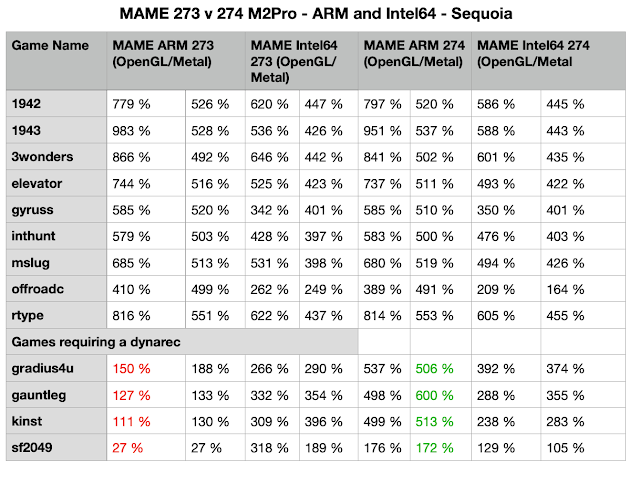
Just a few days after my post on Intel64 builds, these thoughts became redundant because MAME 0.274 for Silicon Macs (along with other ARM64 platforms) received a dynamic recompiler. This finally brings MAME on modern Macs fully en par with Intel64 platforms and makes the Intel64 builds redundant for Silicon Macs.

That's a lot of benchmarks!

These benchmarks speak for themselves: The new dynarec lets my M2Pro Mac fly in games requiring a dynarec. Besides the listed games, probably all games requiring a CHD (Compressed Harddisk) will gain such dramatic performance improvements.

On the RetroArch side of things, the improvements are less dramatic. In games requiring a CHD, I still see games suffer, e.g. gauntleg. This will require further testing. But for complex games, MAME official is now a safe bet on modern Silicon Macs.

06 January 2025

Mac MAME Advanced: Intel Build besides Silicon Build

It seems that one of the major drawbacks of current MacOS MAME is the lack of a Dynamic Recompiler (dynarec), which is only available for Intel64 builds. Modern Arcades can crawl even on very powerful Silicon Macs if the games relies on a dynarec. This is where an Intel build comes to the rescue.

Comparison between ARM/Silicon and Intel64 Build

What this comparison tells you:

  • The ARM build fares much better in old school gaming that don't require a dynarec. 
  • The Metal backend seems to catch up with the OpenGL backend, which is still faster. 
  • The performance gains with an Intel64 build in games that require a dynarec are dramatic.
So here is a current Intel64 build of MAME 0.273 on Github, compiled today:

16 July 2024

This July - Hot Emulation News

While during summer, computing tends to slow down a bit, this is certainly not true for the emulator scene. Let's just list the big news that also are relevant for Mac Retrogaming:

  • RetroAchievements for Game Cube has landed! Download the most recent development build for MacOS (Universal build) and log into your RetroAchievements account via Tools - done! There is already a huge list of supported GameCube titles - with some luck also those of your own childhood. Needless to tell that should you have missed out on RetroAchievements, it is about time! This is absolutely breaking news. I just fired up my beloved Luigis Mansion, and RetroAchievements immediately activated on my Mac!
  • PCSX2 enters a new era: The developers have completed migration to QT and thereby release version 2! Having said that, Silicon Macs still rely on Rosetta2 - but the IntelMac builds are reasonably fast and absolutely stable.
  • Mupen64Plus 2.6: Believe it or not, it's the first release since 5 years. There are pre-built releases, however only for Intel64. While I could not test it, my build instructions for an Apple Silicon build should still work.
  • Duckstation frequently updates: It's definitely also worth updating Duckstation to its most recent version. Besides tons of under the hood development, also further shaders landed. Also here I still need to come back later.
With that said, back into this hot summer ... enjoy some shiny summer days!

07 June 2024

Exciting RetroArch Updates - Official Apple AppStore Availability

The RetroArch community remains very busy and provides for another big thing - RetroArch is now downloadable for iOS/iPadOS/tvOS from the official Apple App Store.


According to the libretro.com website, also an official app for MacOS is in the making, but that's not so important anyways.

But this app iOS/iPadOS/tvOS is a big step forward, as you no longer need to care about sideloading or even jailbreaking your mobile device. Installation and updates from the official Apple App Store work like a breeze. Big thanks to the libretro community for such good progress.

If you are really into RetroArch on Apple mobiles, I can highly recommend you this third-party app for all your file transfershttps://imazing.com/ - yes, it costs money, but it's worth every cent. A very smart way of managing your devices and transfering data from and to it.

At this occasion, I also updated my two RetroArch tutorials:

All in all, RetroArch continues to be a cornerstone of Mac emulation.


08 February 2024

RetroArch Tutorial Part III - Usage 101 / Best Practices

After two tutorials on a proper RetroArch setup (Part I and Part II), this might be the most difficult Part III on best practices in RetroArch. Frankly, it's an attempt and I will see where this heads to.

Hello RetroArch!
I do hope it's fine to use your great logo here :-).

RetroArch Menu Styles

While I stick to the pragmatic new menu layout of ozone, you can also check the different layouts which RetroArch offers. Look for: Settings/User Interface/Menu (change requires a save and restart)

06 February 2024

RetroArch 1.17 release & RetroArch Setup Tutorial - Part II

Update June 2024: Besides minor tweaks all over the document, I included a dedicated RetroArch Cloud Sync section for FinalBurn Neo, as this cannot be put into the official documentation.

This February 2024, RetroArch reached another milestone with the release of the stable version 1.17. The significance of this frontend for the emulation community cannot be overestimated - it's the foundation/inspiration for many other projects and of course the home of an ever growing list of cores that run under this frontend. But it's also a steady inspiration for new concepts and ideas - with some of these ideas remaining in an experimental mode, while others becoming very successful and influential.

This is a follow-up to this post about configuring RetroArch from scratch - Part I.

So let's start Part II of the RetroArch tutorial with a focus on Arcade games - but most of this applies to other cores as well. As you may expect, this post is work in progress and will grow over time. If you are interested in some special RetroArch topics, just leave a comment below.

Even with 1.17 being out, let me suggest to use nightly builds.

1. Use nightly MacOS builds: 

The nightly MacOS builds of RetroArch have now been stable for several years. I can recommend using them instead of the stable builds. For example, new version 1.2.7 of MoltenVK (the Vulkan layer for MacOS) just landed two days after the stable 1.17 - apparently, this plugin is essential for RetroArch in MacOS, so you would not want to miss this update. But I do not mean that you should update RetroArch every day, but if you do, download a nightly build to benefit from the latest updates.

If things turn out strange for you, you can easily downgrade by installing the stable version over the nightly build. As shown in Part I, updating the app is simple, and you will not loose any of your settings.

13 January 2024

Arcade Emulation on Macs - Status Report December 2023

Update 13 January 2024: Further great news for all Aracade fans.

1942 has RetroAchievements! One of my all-time arcade favorites finally received nice Achievements. Needless to tell that I won't master this set at any point in time, but for all you hardcore gamers, this is definitely something to head for.

OpenEmu 2.41! After some two years, the emulator with a MacOS feeling, OpenEmu, has been finally updated again. If you download the "Experimental" version, you also receive a MAME 250 core. One word of caution: It is still Intel only. However, some initial testing on my M2 Mac mini showed nice performance. In MacOS Sonoma, OpenEmu also activates the Gaming Mode in fullscreen. I certainly will always prefer RetroArch/FinalBurn Neo, but if you want to engage into all this configuration hassles, OpenEmu is worth a try.

Update 22 December 2023: Have a good festive season with a lot of good arcade gaming! These great news will help you so spend some quality gaming time. I also tweaked the main text a bit. Cheers!

Bubble Bobble has RetroAchievements! The wait is over, and these Achievements are pure joy. RetroArch and FinalBurn Neo (don‘t forget to turn the koko-aio shaders on, and my repository of course contains dedicated artwork). It’s a great experience and raises this brilliant game to a new level.

AttractMode Plus updated to 3.0.7, the signed app for Silicon Macs is online: https://github.com/oomek/attractplus/releases/tag/3.0.7

Arcadeflow layout for AttractMode Plus updated to 16.7, grab it here: https://github.com/zpaolo11x/Arcadeflow/releases/tag/16.7

Happy holidays! And again: All here strictly non-commercial, i.e. no ads, and any comments trying to benefit will be removed.

———————

Inspired some interesting reads out there (Dolphin Emu progress reports, PCSX2 progress reports, and last but not least https://www.readonlymemo.com/) I do this status report in December 2023 on Mac Arcade emulation (including iOS emulation).  Don't get me wrong: Those emu progress reports are much more into technical stuff than this blog - still the format inspires. And it's also a very good moment to do this, as there is a lot of good things to report. And before you ask: No tvOS experience here, sorry ;-).

In short: Arcade emulation on Macs/iOS was never better than now. Let's discuss why.

(1) MacOS Sonoma: Upgrading to the latest MacOS from Ventura was hassle-free. The new OS just works, and so do all emulators so fae (and Homebrew, most importantly). For sure, you will ask about this Game Mode that landed in MacOS for the first time. Happy to report that RetroArch properly launches in Game Mode when in fullscreen (MacOS tells you this with a notification each launch). 

Apologies for Shots in German ;-).


However, MAME official does not seem to launch in Game Mode (at least no notification pops up). Don't ask me about any performance differences, which are anyways hard to measure in RetroArch. But according to the official documentation (link above), it should definitely be no disadvantage for the gaming experience. 

In short: Sonoma is good to head for.

(2) FinalBurn Neo (RetroArch Core for MacOS/iOS): This core continues to impress and remains a clear number one in Mac Arcade emulation. The RetroArch documentation provides a nice summary of the main differences between MAME and FinalBurn Neo: https://docs.libretro.com/library/fbneo/ - in short, FinalBurn Neo takes compromises on accuracy in favor of playability by accepting 'quality of life hacks' that MAME doesn't. Since my latest post on this core (actually a full setup guide on RetroArch for Arcade games), the developers took huge efforts to stay in sync with MAME official (as of this post, this is version 261). Highscore support further increased for my favorite games. And most importantly, it is the only reliable RetroArch arcade core for RetroAchievements. Remember: For playing in HC Mode (the real thing without save states and rewind), you need to disable the rom hack core option when running FBNeo and restart.

In short: FinalBurn Neo remains the best Arcade emulator on MacOS/iOS systems.